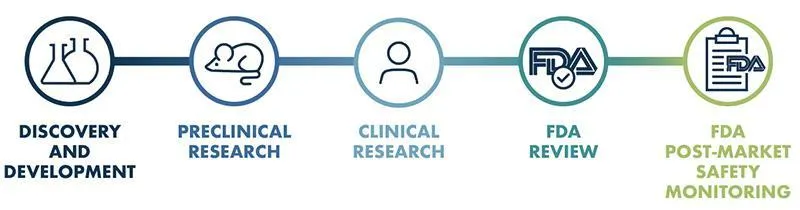
Let’s review the key information.
Overall, the entire drug development process (from discovery to approval and marketing) can take 10-15 years or even longer.
This timeline varies based on factors like the complexity of the disease being targeted; how efficiently clinical trials are run; how difficult it is to meet exacting regulatory requirements; and managing unforeseen challenges during the process. Conducting rigorous, careful science while patients’ lives hang in the balance is anything but fast and easy!
1. Discovery
The timeline for discovery varies depending on the medical need and technical challenge. Discovery can involve everything from screening thousands of compounds to see if they have the desired effect, to specifically engineering monoclonal antibodies to recognize a certain protein.
Discovery typically includes target identification (finding a protein or receptor to attack) and lead optimization (making the compound more effective and safer before it goes into animals).
2. Preclinical
Before testing a drug in humans, researchers conduct preclinical studies in laboratories and in animal models to determine whether the drug is safe and effective enough to move onto clinical trials in humans.
Preclinical studies typically last around three to six years, and can include anything from laboratory studies to in vivo animal tests. These studies are designed to assess a drug candidate’s safety, toxicity, and potential effectiveness.
2. Investigational New Drug (IND) Application
Before a biotech or pharma company can test a drug in humans, its sponsor submits an IND application to the FDA.
This application includes the key preclinical data and proposed clinical trial plan. Once the IND is approved, human clinical trials can begin.
(Continued on the next page…)